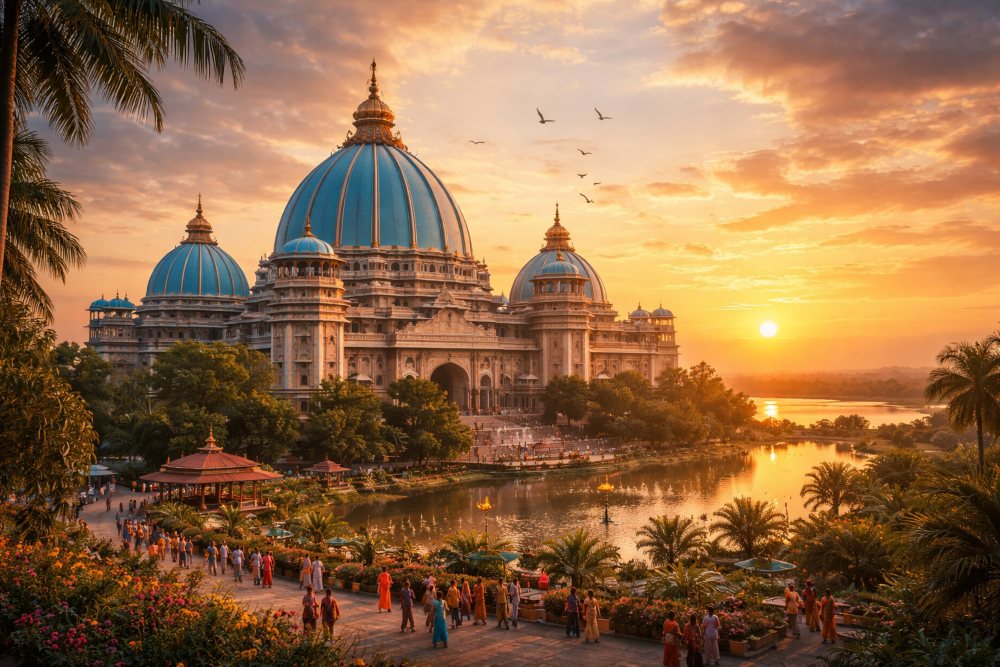
Cultural and Spiritual Importance of Mayapur Temple
Mayapur Temple is not simply a historical monument or a regional pilgrimage site; it represents one of the world’s most comprehensive living spiritual ecosystems. Situated on the sacred banks of the Ganges in West Bengal, Mayapur is revered as the birthplace of Sri Chaitanya Mahaprabhu, the spiritual visionary who revived the Bhakti movement in the fifteenth century. Over centuries, this sacred geography has evolved into the international headquarters of the International Society for Krishna Consciousness (ISKCON), transforming Mayapur into a global spiritual nucleus. What distinguishes Mayapur from most religious destinations is that it does not merely preserve relics of the past — it actively sustains spiritual discipline, ethical culture, philosophical scholarship, and communal harmony in daily life. Pilgrims, scholars, spiritual practitioners, and cultural researchers from more than one hundred countries visit Mayapur annually to study, serve, meditate, and immerse themselves in a living spiritual tradition.
The cultural and spiritual importance of Mayapur Temple extends far beyond religious ritual. It influences social behavior, environmental ethics, artistic creativity, leadership development, and intercultural dialogue. Unlike conventional temples that function primarily as worship spaces, Mayapur operates as a fully integrated spiritual city where values are embodied through institutional systems. Understanding Mayapur therefore requires examining not only its history but also the operational mechanisms that sustain its spiritual vitality across generations.
Sacred Origins and Historical Continuity of Mayapur
The spiritual identity of Mayapur originates in Navadvipa Dham, the region where Sri Chaitanya Mahaprabhu appeared in 1486 CE. Mahaprabhu introduced a transformative spiritual model centered on bhakti, or loving devotion to the Divine, emphasizing humility, compassion, and universal accessibility. His teachings challenged rigid social hierarchies and ritual exclusivity, offering spiritual participation to people regardless of caste, education, or nationality. Through congregational chanting of sacred names, spiritual realization became experiential rather than theoretical.
After Mahaprabhu’s departure, his disciples and successive generations of saints preserved this tradition through oral transmission, scriptural scholarship, and community organization. Monasteries, temples, and learning centers emerged across Bengal, maintaining doctrinal integrity while adapting to social change. When modern colonial and postcolonial disruptions threatened indigenous spiritual systems, Mayapur remained resilient due to its embedded community practices rather than reliance on royal patronage or political support.
The modern revival of Mayapur gained momentum through A.C. Bhaktivedanta Swami Prabhupada, who globalized Gaudiya Vaishnavism in the twentieth century. By establishing ISKCON and positioning Mayapur as its international headquarters, Prabhupada ensured institutional continuity, standardized education, and global connectivity. This uninterrupted historical lineage makes Mayapur a rare example of living spiritual continuity rather than archaeological preservation.
Philosophical Foundation and Living Theology
At the heart of Mayapur lies the philosophical system of Gaudiya Vaishnavism, which integrates metaphysics, ethics, psychology, and devotional practice into a coherent worldview. The tradition teaches that consciousness is fundamental to reality and that the soul’s natural function is loving service to the Divine. Liberation is not conceived as escape from existence but as restoration of harmonious relationship with ultimate consciousness.
This philosophy is not confined to intellectual debate. In Mayapur, theology shapes daily behavior, interpersonal ethics, dietary discipline, leadership norms, and environmental responsibility. Residents internalize values such as humility, truthfulness, nonviolence, self-discipline, and compassion through practical application rather than abstract instruction. Scriptural study encourages analytical thinking and ethical reasoning rather than blind belief.
The living theology of Mayapur demonstrates how philosophical systems can actively regulate social conduct and emotional development, making spirituality a functional life science rather than metaphysical speculation.
Temple Architecture as Cultural Language
Architecture in Mayapur functions as a cultural language encoding spiritual philosophy through form, proportion, and symbolism. The Temple of the Vedic Planetarium represents one of the most ambitious sacred architectural projects of the modern era, integrating ancient cosmological models with contemporary engineering. Sacred geometry, directional alignment, acoustics, and spatial sequencing influence sensory perception and psychological state.
Visitors experience a gradual transition from external distraction to internal focus as they move through temple spaces. Light, sound resonance, spatial openness, and material texture collectively shape contemplative awareness. Architectural symbolism communicates cosmic order, ethical harmony, and transcendental aspiration without reliance on textual explanation.
Such architectural literacy preserves cultural memory and transmits spiritual meaning across generations and cultures.
Ritual Culture and Spiritual Discipline
Ritual practice in Mayapur follows ancient Pancharatra standards governing purification, mantra recitation, ceremonial timing, and ethical conduct. Ritual precision ensures continuity of vibrational integrity and symbolic coherence. Priests undergo years of training to master procedural accuracy, Sanskrit pronunciation, and behavioral discipline.
Participation in rituals trains attentional control, patience, humility, and emotional regulation. Ritual rhythm structures daily time, preventing chaotic lifestyle patterns. Rather than superstition, ritual serves as cognitive conditioning shaping ethical awareness and behavioral consistency.
The persistence of ritual discipline sustains spiritual continuity beyond individual belief fluctuations.
Festivals as Cultural Memory and Social Cohesion
Festivals in Mayapur function as collective memory systems encoding history, theology, mythology, and community values. Celebrations integrate music, drama, discourse, ritual procession, and service participation. These events create immersive learning environments that transmit knowledge through sensory experience rather than abstract teaching.
International participation during festivals reinforces cultural exchange and global unity. Shared celebration dissolves social boundaries and strengthens collective identity. Festivals also reinforce generational continuity as children absorb tradition experientially.
This cyclical cultural reinforcement maintains spiritual vitality and prevents cultural stagnation.
Education, Scholarship, and Knowledge Preservation
Mayapur operates as a spiritual education hub where students receive systematic training in Sanskrit, theology, leadership ethics, cultural arts, sustainability science, and community governance. Translation projects preserve scriptural accuracy while making texts accessible globally. Digital archives protect sacred literature from loss while enabling academic research.
Peer review, curriculum oversight, and interdisciplinary collaboration strengthen intellectual credibility. Knowledge transmission ensures that tradition evolves intelligently without dilution.
Education transforms spiritual culture into a sustainable knowledge ecosystem.
Arts, Music, and Cultural Expression
Devotional music, dance, painting, sculpture, and sacred drama preserve aesthetic heritage while enabling creative innovation. Art functions as emotional education, transmitting values intuitively. Cultural expression sustains vibrancy and accessibility across linguistic boundaries.
Ecological Ethics and Sustainable Living
Mayapur integrates organic agriculture, renewable energy, water conservation, waste management, and animal welfare into daily operations. Environmental stewardship emerges as spiritual responsibility rather than political ideology.
Residents experience sustainability as lived practice, reinforcing ethical accountability.
Community Organization and Social Harmony
Governance structures emphasize servant leadership, conflict resolution, accountability, and participatory decision-making. Social cohesion emerges through shared values rather than coercive regulation.
Global Influence and Cultural Diplomacy
ISKCON’s international network transmits Mayapur’s spiritual culture worldwide through temples, education centers, humanitarian programs, and digital platforms. Mayapur functions as a cultural ambassador for Indian spiritual heritage.
Psychological and Transformational Impact
Pilgrims experience emotional clarity, ethical motivation, resilience, and inner stability. Spiritual discipline supports mental health and purposeful living.
Modern Relevance and Future Vision
Mayapur demonstrates how ancient wisdom addresses modern challenges such as mental health crises, environmental degradation, leadership ethics, and social fragmentation.
Conclusion
The cultural and spiritual importance of Mayapur Temple lies in its ability to function as a living civilization rather than a static monument. Through integrated systems of education, ritual, governance, sustainability, and cultural expression, Mayapur preserves ancient wisdom while guiding modern humanity toward ethical harmony and inner transformation.