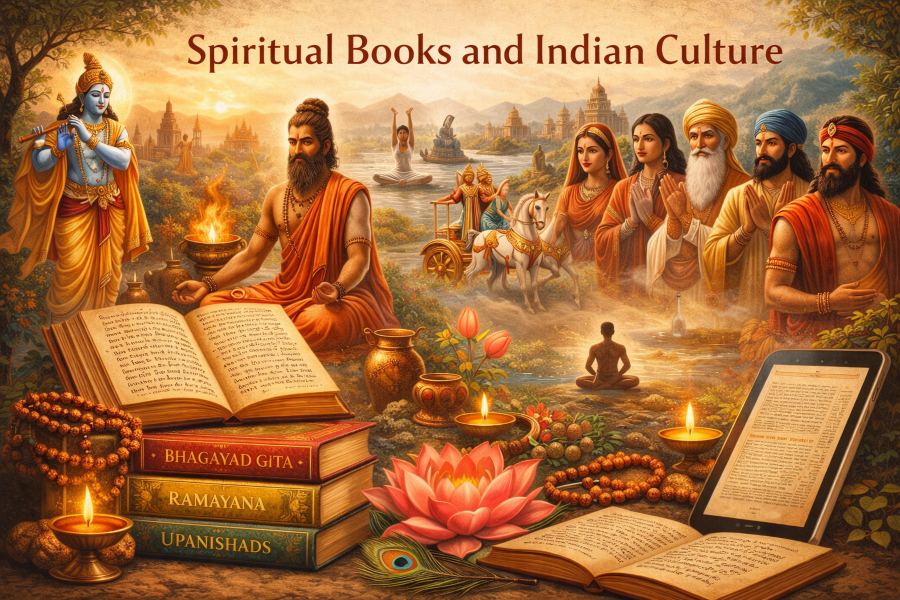
Spiritual Books and Indian Culture: How Sacred Literature Shapes Values, Identity, and Conscious Living
Introduction
India is widely recognized as a spiritual civilization where knowledge, self-realization, and ethical living have shaped society for thousands of years. Unlike cultures driven mainly by material progress, Indian culture places deep emphasis on inner growth, moral responsibility, and harmony with nature. At the heart of this tradition lies an extraordinary collection of spiritual books that guide individuals toward wisdom, discipline, and compassionate living.
From the Vedas and Upanishads to the Bhagavad Gita, Ramayana, Mahabharata, Puranas, and Bhakti literature, spiritual texts have preserved India’s philosophical identity and cultural continuity. These books are not merely religious documents; they function as social guides, ethical frameworks, educational resources, and psychological manuals. Even today, spiritual literature continues to influence personal development, leadership values, social harmony, and global spiritual movements.
This article explores how spiritual books shape Indian culture, preserve timeless wisdom, and remain relevant in the modern world.
The Foundation of Spiritual Knowledge in Indian Civilization
Indian civilization developed around the belief that knowledge should liberate the mind and elevate consciousness. Ancient sages emphasized self-inquiry, discipline, compassion, and service as pathways to human fulfillment. Spiritual books emerged as repositories of this collective wisdom.
Unlike purely theoretical philosophy, Indian spiritual literature integrates practical life guidance with metaphysical understanding. Concepts such as Dharma (righteous duty), Karma (cause and effect), Bhakti (devotion), and Moksha (liberation) form the ethical backbone of Indian society. These principles influence family relationships, education systems, governance ethics, and personal behavior.
Spiritual books also established India’s oral tradition, where teachers transmitted knowledge verbally to preserve accuracy and depth. This tradition strengthened memory, interpretation skills, and community learning.
The Vedas and Upanishads: The Roots of Spiritual Thought
The four Vedas represent the earliest spiritual foundation of Indian culture. They contain hymns, rituals, philosophical reflections, and scientific observations. The Rigveda explores cosmic order and natural harmony. The Yajurveda focuses on disciplined action. The Samaveda emphasizes sound and meditation. The Atharvaveda addresses social life and healing practices.
The Upanishads expanded these teachings by exploring self-awareness and universal consciousness. They introduced the idea that the soul and cosmic reality are interconnected. This realization shaped meditation practices, yoga philosophy, and ethical discipline in Indian culture.
These texts encouraged inquiry rather than blind belief, making Indian spirituality intellectually open and adaptable.
Epics as Cultural Teachers: Ramayana and Mahabharata
The Ramayana and Mahabharata are cultural foundations of Indian moral education. These epics transmit ethical lessons through relatable human stories rather than abstract philosophy.
The Ramayana teaches ideals of loyalty, sacrifice, courage, family responsibility, and righteous leadership. Characters embody virtues that influence social expectations and personal conduct.
The Mahabharata explores complex ethical dilemmas, emotional conflicts, political responsibility, and spiritual growth. The Bhagavad Gita within the epic provides guidance on selfless action, mental discipline, and devotion.
Through festivals, theater, storytelling, and education, these epics shape collective values and national identity.
Puranas and Cultural Continuity
The Puranas preserve mythology, genealogy, cosmology, pilgrimage traditions, and moral storytelling. They made spiritual knowledge accessible to common people through engaging narratives and symbolic teaching methods.
Temples, festivals, rituals, and pilgrimage routes evolved based on Puranic traditions. Community identity and regional culture grew through shared stories and devotional practices.
Puranic literature supports social cohesion by creating cultural continuity across diverse linguistic and geographic regions.
Bhakti Literature and Social Transformation
Bhakti movement literature transformed Indian culture by emphasizing personal devotion over ritual hierarchy. Saints like Kabir, Mirabai, Tulsidas, Surdas, and Chaitanya Mahaprabhu promoted equality, love, humility, and spiritual accessibility.
Their poetry crossed caste and class barriers and united communities through devotional music and storytelling. Bhakti literature strengthened emotional spirituality and community participation while promoting social harmony.
Regional Spiritual Literature and Linguistic Diversity
India’s spiritual heritage flourishes across multiple languages:
- Tamil literature preserves ancient devotional hymns and ethical philosophy.
- Bengali literature blends humanism with spiritual depth.
- Marathi and Gujarati traditions emphasize devotion and social reform.
- Urdu poetry explores divine love and philosophical reflection.
This diversity ensures cultural inclusiveness and creative expression while preserving spiritual unity.
Spiritual Books and Daily Life Practices
Indian daily life integrates spiritual teachings into routine activities:
- Morning prayers and meditation
- Yoga and breathing practices
- Fasting and discipline
- Charity and service
- Respect for elders and teachers
Spiritual books guide ethical decision-making, emotional control, and lifestyle balance. Festivals, rituals, and family customs reflect literary teachings.
Influence on Education and Knowledge Systems
Ancient gurukuls emphasized character development alongside intellectual learning. Spiritual texts trained students in discipline, humility, memory, debate, and self-control.
Modern education institutions integrate philosophy, ethics, yoga studies, and cultural history to maintain holistic development.
Spiritual literature promotes lifelong learning and moral responsibility.
Leadership and Governance Influence
Indian political philosophy historically drew from spiritual ethics. Kings were expected to rule based on justice, compassion, and public welfare.
Modern leadership programs still study spiritual principles for emotional intelligence, decision-making ethics, and stress management.
Mental Health and Emotional Wellbeing
Spiritual teachings emphasize detachment, awareness, gratitude, and inner peace. These principles align with modern psychology and mindfulness practices.
Meditation and self-reflection reduce stress, anxiety, and emotional instability.
Global Impact of Indian Spiritual Books
Indian spiritual texts have influenced global philosophy, yoga movements, wellness culture, and academic research. Translations introduced Eastern wisdom worldwide.
Digital Preservation and Modern Accessibility
Digital libraries, audiobooks, translations, and online courses make spiritual literature accessible globally while preserving manuscripts.
Challenges and Preservation Needs
Language loss, declining reading habits, and commercialization threaten heritage. Preservation requires education investment, translation, youth engagement, and digitization.
Spiritual Books as Cultural Identity Anchors
Spiritual literature shapes national identity, ethical unity, and cultural pride while encouraging tolerance and diversity.
Conclusion
Spiritual books remain the backbone of Indian culture. They guide ethical living, preserve wisdom, strengthen identity, and inspire global harmony. Their relevance continues across generations.