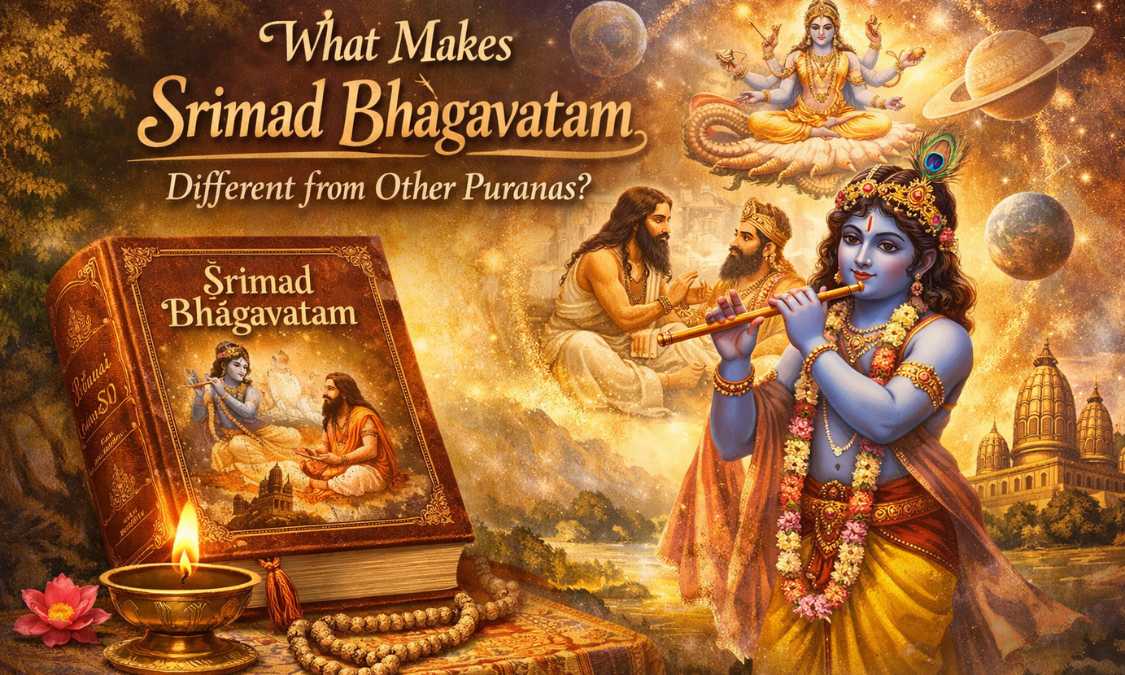
What Makes Srimad Bhagavatam Different from Other Puranas?
Introduction
The vast ocean of Vedic literature contains many sacred texts that guide humanity toward truth, righteousness, and spiritual realization. Among these revered scriptures, the Puranas hold a special place as accessible narrations of divine wisdom, history, cosmology, and moral instruction. There are traditionally eighteen Mahāpurāṇas and numerous Upapurāṇas, each serving a unique spiritual purpose.
Yet among all these sacred works, the Srimad Bhagavatam (Bhagavata Purana) stands apart as a timeless spiritual masterpiece. Revered by saints, scholars, and devotees alike, it is often described as the ripened fruit of the Vedic tree and the highest expression of devotional theology. Unlike other Puranas that balance ritual, mythology, and social instruction, Srimad Bhagavatam focuses entirely on pure devotion (bhakti) and direct realization of God.
But what exactly makes Srimad Bhagavatam different from other Puranas? Why has it inspired global spiritual movements, including the Vaishnava tradition and ISKCON? Why do seekers across cultures consider it a living scripture rather than a historical text?
This in-depth article explores the philosophical depth, spiritual uniqueness, narrative structure, devotional focus, and transformative power that elevate Srimad Bhagavatam above all other Puranic literature.
Understanding the Puranas: A Brief Overview
The word Purana means “ancient” or “that which renews.” Puranas preserve spiritual wisdom through stories, genealogies, cosmology, legends of kings and sages, and descriptions of divine incarnations.
Traditional Puranas cover five main topics:
- Creation of the universe (Sarga)
- Secondary creation and cosmic cycles (Pratisarga)
- Genealogy of gods and sages (Vamsha)
- Manu periods and human history (Manvantara)
- Dynasties of kings (Vamshanucharita)
Most Puranas emphasize different aspects of divine worship:
- Some promote karma and ritual.
- Some focus on knowledge and renunciation.
- Others glorify particular deities such as Shiva, Devi, or Vishnu.
While all Puranas guide spiritual growth, Srimad Bhagavatam transcends these categories and presents a unified spiritual vision centered on loving devotion.
Srimad Bhagavatam: The Crown Jewel of Puranic Literature
Srimad Bhagavatam was composed by Ved Vyasa, the compiler of the Vedas, after he experienced inner dissatisfaction even after completing massive literary works. On the advice of his spiritual master Narada Muni, Vyasa composed Srimad Bhagavatam to glorify the Supreme Lord purely and without material motivation.
The text consists of 12 cantos, 335 chapters, and over 18,000 verses. It narrates divine incarnations, cosmic philosophy, spiritual psychology, and especially the loving pastimes of Lord Krishna.
Unlike other Puranas, Srimad Bhagavatam was spoken as a continuous spiritual discourse by Shukadeva Goswami to King Parikshit, who was facing imminent death. The urgency of spiritual realization gives the entire scripture intense depth and focus.
Pure Bhakti as the Central Message
Devotion Without Material Motivation
Most Puranas mix devotion with worldly benefits—health, wealth, prosperity, heavenly pleasures, or liberation. Srimad Bhagavatam rejects all secondary motivations and teaches unconditional devotion to God.
It defines true religion as:
Loving service to the Supreme without selfish desire or interruption.
This uncompromising spiritual purity is rarely found so clearly expressed elsewhere.
Emotional Relationship with God
Bhagavatam presents God not as a distant ruler but as a loving friend, child, beloved, and protector. Readers encounter Krishna’s playful childhood, His friendships, His divine love, and His compassionate guidance. This emotional intimacy transforms spirituality from ritual into a living relationship.
READ ALSO:- Life Lessons from the Mahabharata for Modern Times
Highest Philosophical Clarity
Harmonizing Knowledge, Devotion, and Action
Many scriptures emphasize either action (karma), knowledge (jnana), or devotion (bhakti). Srimad Bhagavatam harmonizes all three while establishing bhakti as the ultimate goal.
It explains:
- Why material attachment causes suffering.
- How detachment arises naturally through devotion.
- How knowledge becomes meaningful only when connected to loving service.
Clear Definition of the Absolute Truth
Bhagavatam describes the Absolute Truth in three progressive realizations:
- Brahman – spiritual energy
- Paramatma – divine presence in the heart
- Bhagavan – the Supreme Personality of God
This clarity removes confusion about God’s identity and establishes a personal divine reality.
Spiritual Psychology and Inner Transformation
Deep Analysis of the Mind and Consciousness
Srimad Bhagavatam explains how desires, ego, fear, attachment, and ignorance shape human destiny. Through stories and dialogues, it reveals:
- How the mind traps the soul in repeated suffering.
- How devotion purifies subconscious tendencies.
- How remembrance of God transforms consciousness.
Modern psychology increasingly recognizes mindfulness and consciousness studies — Bhagavatam explored these dimensions thousands of years ago.
Liberation Through Love, Not Escape
Unlike philosophies that seek liberation by rejecting the world, Bhagavatam teaches liberation through positive engagement — loving service that naturally dissolves ego and suffering.
Krishna-Centered Divine Narratives
Supreme Position of Lord Krishna
While many Puranas glorify various deities, Srimad Bhagavatam establishes Krishna as the original Supreme Personality of Godhead, from whom all incarnations expand.
His childhood pastimes in Vrindavan represent divine love at its highest purity. These narratives are not mythology but spiritual revelations meant to awaken dormant devotion.
Spiritual Aesthetics and Beauty
The poetic beauty of Bhagavatam elevates consciousness. Its descriptions of forests, rivers, moonlit nights, temples, celestial beings, and divine emotions create a spiritual environment for the reader’s mind.
Universality Beyond Religion and Culture
Universal Spiritual Principles
Bhagavatam transcends religious boundaries by addressing universal human struggles:
- Fear of death
- Desire for happiness
- Search for meaning
- Longing for love and belonging
Its teachings apply equally to householders, monks, leaders, students, and seekers of all backgrounds.
Adaptability Across Time
Despite being ancient, its wisdom addresses modern problems such as:
- Anxiety and depression
- Material obsession
- Identity crisis
- Environmental imbalance
- Relationship conflicts
Living Scripture Through Oral Tradition
Power of Hearing (Shravanam)
Srimad Bhagavatam emphasizes the spiritual power of hearing sacred sound vibration. The tradition of Bhagavat Katha keeps the scripture alive through spoken narration and devotional singing.
Unlike texts meant primarily for academic study, Bhagavatam is designed to be experienced emotionally and spiritually.
Transformational Impact on Listeners
Throughout history, countless saints and ordinary people have experienced life transformation simply by hearing Bhagavatam regularly.
Scientific and Cosmological Depth
Advanced Cosmology
Bhagavatam describes multi-dimensional universes, cycles of creation, time dilation, and consciousness-based reality — concepts that modern physics continues to explore.
Consciousness as Fundamental Reality
Unlike material science which focuses on matter, Bhagavatam identifies consciousness as the foundation of existence.
Ethical and Social Guidance
Dharma Rooted in Compassion
Bhagavatam teaches ethical living based on compassion, humility, self-control, honesty, and service rather than fear-based morality.
Leadership and Governance Lessons
Stories of righteous kings like Prithu, Ambarisha, and Yudhishthira provide timeless leadership models grounded in service, integrity, and spiritual accountability.
Depth of Emotional Devotion (Rasa Theology)
Srimad Bhagavatam uniquely explains spiritual emotions (rasas):
- Peacefulness
- Servitude
- Friendship
- Parental affection
- Romantic love
This emotional theology is unparalleled in world literature.
Final Teaching: Love Is the Ultimate Truth
The ultimate message of Srimad Bhagavatam is simple yet profound:
The soul’s eternal purpose is loving service to God.
All knowledge, rituals, discipline, and philosophy ultimately serve this realization.
Conclusion
Srimad Bhagavatam is not merely a Purana — it is a complete spiritual universe. Its unmatched focus on pure devotion, philosophical clarity, emotional depth, universal relevance, and transformative power makes it unique among all sacred texts.
While other Puranas guide humanity through duty, mythology, and cosmic order, Srimad Bhagavatam leads the soul directly into a loving relationship with the Divine.
For anyone seeking inner peace, purpose, and eternal happiness, Srimad Bhagavatam remains a timeless spiritual companion and guide.