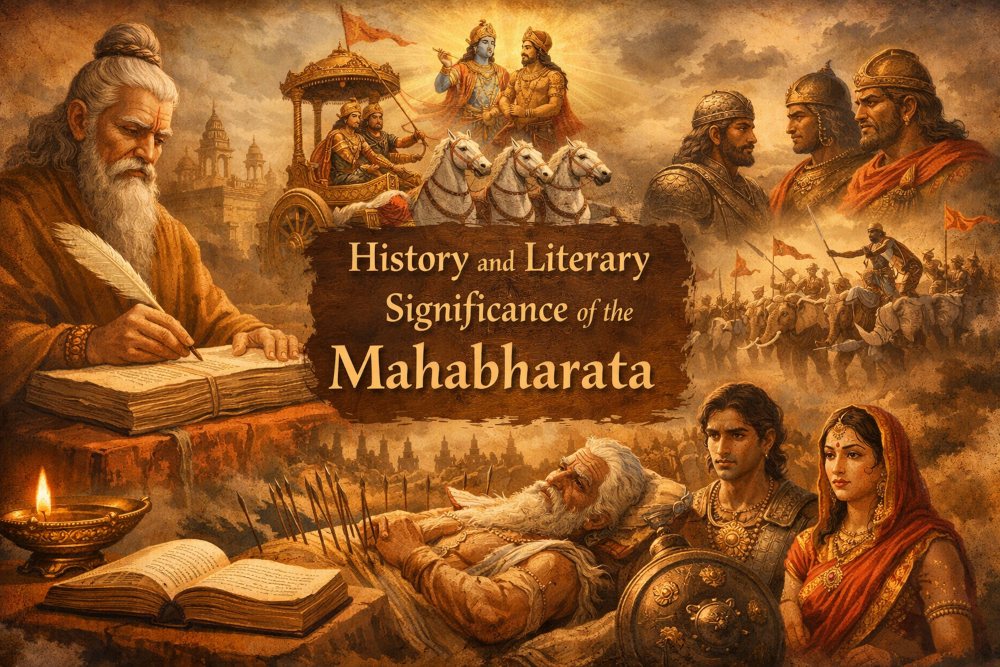
History and Literary Significance of the Mahabharata
The Mahabharata stands as one of humanity’s greatest intellectual and spiritual achievements, shaping philosophy, culture, literature, and ethical thinking for thousands of years. Today, scholars, devotees, and readers across the world explore authentic editions from trusted sources such as the ISKCON Official Mayapur Store to experience the epic in its original depth and spiritual integrity. Far beyond a legendary war narrative, the Mahabharata represents a complete encyclopedia of human life, integrating history, mythology, politics, ethics, psychology, devotion, and metaphysics into one monumental literary masterpiece.
This epic continues to influence education systems, leadership philosophy, religious traditions, and artistic expression across civilizations. Its layered storytelling and philosophical depth make it not only a religious scripture but also a timeless literary treasure studied by historians and literary scholars worldwide.
Origins and Traditional Authorship
The Mahabharata is traditionally attributed to the sage Vyasa, also known as Krishna Dvaipayana. According to classical tradition, Vyasa composed the epic and dictated it to the deity Ganesha, who served as the divine scribe. While this account belongs to spiritual tradition, historical scholars recognize the Mahabharata as a composite work developed over several centuries through oral transmission before being compiled into written form.
The earliest layers of the Mahabharata likely emerged between 1500 BCE and 500 BCE, with subsequent expansions continuing until around 400 CE. This long evolutionary process allowed diverse regional traditions, philosophical ideas, and cultural values to merge into a unified narrative. The epic grew organically as generations of storytellers preserved and refined its verses.
This dynamic development contributes to the Mahabharata’s richness and diversity of perspectives, making it a living text rather than a static composition.
Oral Tradition and Preservation
Before written manuscripts existed, the Mahabharata was preserved through oral recitation. Professional bards memorized thousands of verses and transmitted them accurately across generations. Strict rhythmic patterns and poetic structures helped maintain textual consistency.
This oral tradition enabled the epic to reach diverse communities long before widespread literacy. It also allowed regional adaptations while preserving the core philosophical themes. When writing systems became more accessible, the epic was transcribed into manuscripts on palm leaves, birch bark, and later paper.
Multiple manuscript traditions emerged across India, leading to variations in verse count and narrative detail. Modern critical editions have attempted to reconstruct the earliest reliable version through comparative scholarship.
Structure and Narrative Complexity
The Mahabharata consists of eighteen major books, known as parvas, containing hundreds of sub-narratives interwoven into the central story of the Kurukshetra war between the Pandavas and the Kauravas. The narrative structure is multilayered, combining historical chronicle, mythological allegory, moral instruction, and spiritual discourse.
Stories within stories create a unique literary architecture that mirrors the complexity of human experience. Readers encounter royal genealogies, philosophical debates, heroic battles, social customs, and devotional hymns within a single epic framework.
This narrative complexity allows the Mahabharata to function simultaneously as entertainment, education, and spiritual guidance.
The Bhagavad Gita: Literary and Philosophical Core
Embedded within the Bhishma Parva of the Mahabharata, the Bhagavad Gita represents one of the most influential philosophical texts in world literature. Structured as a dialogue between Krishna and Arjuna, it synthesizes multiple schools of Indian philosophy including yoga, devotion, metaphysics, and ethics.
Literarily, the Gita employs poetic precision, metaphorical imagery, and rhythmic elegance to convey profound spiritual truths. Philosophically, it introduces integrated paths of action, knowledge, and devotion, offering a universal framework for balanced living.
The Gita’s literary independence allows it to be studied as a standalone masterpiece while remaining inseparable from the Mahabharata’s narrative context.
Literary Style and Poetic Excellence
The Mahabharata employs classical Sanskrit poetic meters that balance narrative clarity with artistic beauty. Its language ranges from simple storytelling to elevated philosophical discourse, demonstrating remarkable stylistic versatility.
The epic uses vivid imagery, symbolic motifs, dramatic dialogues, and emotional depth to engage readers across intellectual levels. Battle scenes display heroic grandeur, while introspective passages reveal psychological nuance and ethical complexity.
This stylistic diversity contributes to the epic’s enduring literary appeal across cultures and languages.
Character Development and Psychological Depth
One of the Mahabharata’s greatest literary strengths lies in its multidimensional characters. Unlike idealized heroes of simpler epics, Mahabharata characters display moral ambiguity, emotional vulnerability, and psychological realism.
Arjuna struggles with doubt and compassion. Yudhishthira grapples with ethical responsibility. Draupadi embodies resilience and dignity. Karna represents identity conflict and loyalty. Bhishma reflects sacrifice and duty. Krishna embodies divine wisdom and strategic intelligence.
These layered personalities create a psychological realism that anticipates modern literary character development.
Ethical and Philosophical Dimensions
The Mahabharata explores dharma as a dynamic ethical principle rather than rigid law. Through complex moral dilemmas, it examines justice, responsibility, truth, loyalty, sacrifice, and governance.
Philosophical discourses address metaphysics, cosmology, karma theory, devotion, renunciation, and liberation. These discussions elevate the epic beyond narrative entertainment into a comprehensive philosophical encyclopedia.
Historical and Cultural Influence
The Mahabharata profoundly shaped Indian civilization. Its themes influenced legal traditions, political theory, social ethics, and educational philosophy. Artistic traditions such as dance, drama, painting, sculpture, and temple iconography draw extensively from Mahabharata narratives.
Regional languages adopted and adapted the epic, producing countless translations, retellings, and theatrical traditions. Southeast Asian cultures also absorbed Mahabharata themes through cultural exchange.
Manuscript Tradition and Scholarly Studies
Thousands of Mahabharata manuscripts exist across libraries worldwide. Modern critical editions utilize philological analysis to establish textual reliability. Scholars analyze linguistic evolution, narrative stratification, and historical references to understand the epic’s development.
The Mahabharata remains a central subject of Indology, comparative literature, religious studies, and philosophy.
Global Literary Recognition
International thinkers, philosophers, and writers have admired the Mahabharata for its narrative complexity and philosophical depth. It has been translated into numerous world languages, inspiring global readership and academic study.
Its influence extends beyond religious boundaries into universal literary heritage.
Relevance in Contemporary Literature
Modern novels, films, theater productions, leadership training programs, and psychological studies continue referencing Mahabharata themes. Its ethical dilemmas resonate in contemporary political, corporate, and social contexts.
Importance of Authentic Editions
Accurate translation and faithful commentary preserve literary nuance and philosophical integrity. Authentic editions ensure readers access original meanings rather than diluted interpretations.
Conclusion
The Mahabharata’s historical depth and literary brilliance make it one of the greatest achievements of human civilization. Its layered storytelling, psychological realism, philosophical richness, and cultural influence ensure its timeless relevance. As literature, history, and spiritual wisdom converge within this epic, the Mahabharata continues illuminating human consciousness across generations.